

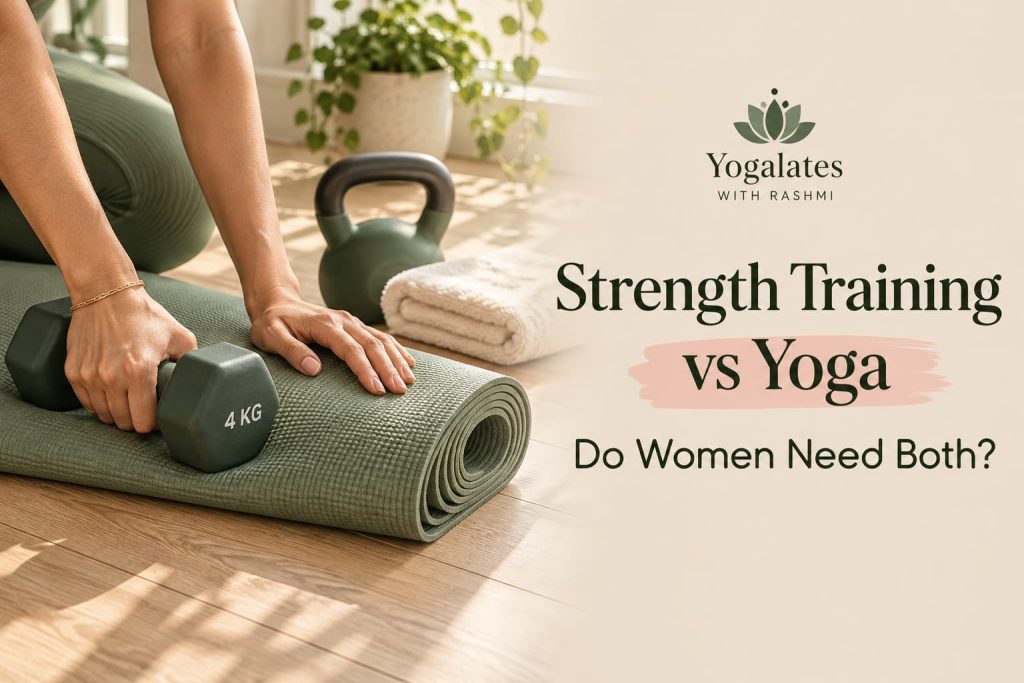
Quick answer: Most women benefit from both. Strength training builds muscle, bone density and metabolism. Yoga builds mobility, balance, breath control and calm. When you compare strength training vs yoga, neither one covers everything on its own. Combining them, even in the same 40-minute session, gives you strength that moves well and lasts.
Strength training for women is everywhere right now. Social feeds are full of dumbbells and kettlebells, and “strong is the new skinny” has replaced older fitness slogans. If you love yoga, it is natural to wonder: do I need to swap my mat for weights?
You don’t. After 15 years of teaching, and after adding serious strength work to my own routine postpartum, I have seen that the question isn’t strength training vs yoga. It is how to make them work together.
What does strength training do for women?
Strength training means working your muscles against resistance: dumbbells, kettlebells, resistance bands or your own bodyweight. For women, the benefits go well beyond toned arms.
- Builds and keeps muscle. Muscle mass naturally declines with age, and the drop speeds up from the mid-30s onwards. Lifting slows it down.
- Supports bone health. Loading your bones through resistance work helps keep them strong, which matters more as oestrogen falls around menopause.
- Boosts metabolism. More muscle means your body uses more energy, even at rest.
- Makes daily life easier. Carrying children, groceries and luggage all get easier when you are stronger.
The World Health Organization recommends that adults do muscle-strengthening activities on at least 2 days a week. Many women still skip this part, especially if walking or yoga is their main exercise. (If walking is your main workout, read Is Walking Enough for Fitness?)
What does yoga do for women?
Yoga trains the things weights often miss.
- Mobility and flexibility: moving your joints through a healthy range of motion.
- Balance and body awareness: knowing where your body is in space, which protects you from falls and injury.
- Breath control: slow, conscious breathing that calms the nervous system.
- Stress relief: a practice that ends in Shavasana gives your mind a real pause.
Yoga does build some strength, especially in holds like plank, chair and warrior poses. But most yoga styles don’t add progressive load, so strength gains level off after a few months.
Strength training vs yoga: a side-by-side comparison
Benefit | Strength training | Yoga | Both together |
|---|---|---|---|
Muscle strength | High | Moderate | High |
Bone health | High | Moderate | High |
Mobility and flexibility | Low to moderate | High | High |
Balance | Moderate | High | High |
Stress relief and breath | Low | High | High |
Metabolism | High | Moderate | High |
Progress you can measure | Easy (weights, reps) | Harder | Easy |
The last column is the point. Each method fills the other’s gaps.
Do women need both strength training and yoga?
Yes, for most women it is the most balanced approach. Here is why the combination works so well:
- Strength without stiffness. Lifting can leave hips, shoulders and hamstrings tight. Yoga keeps them moving freely.
- Better lifting form. Mobility from yoga lets you squat deeper and press overhead safely.
- Faster recovery. Breathwork and stretching after a strength session help you feel ready for the next one.
- Hormone-friendly training. Strength work supports insulin sensitivity and yoga helps manage cortisol. (More on this in Yoga for Hormonal Health.)
- Long-term health. For women over 40, strength plus mobility is one of the best ways to stay independent and pain-free. Read Yogalates for Longevity for more.
When I started lifting heavier postpartum, I loved feeling stronger. But I missed my asana practice, my breath and, yes, my Shavasana. That is exactly why I don’t believe you should have to choose.
Can you do yoga and strength training on the same day?
Yes. The simplest order is strength first, yoga after. Lift while your muscles are fresh, then use yoga to stretch, breathe and cool down.
A balanced 40-minute session looks like this:
- 5 minutes: warm-up with gentle yoga flow or Surya Namaskar
- 20 minutes: strength work with dumbbells, kettlebells or bodyweight
- 10 minutes: Pilates-style core work for stability and control
- 5 minutes: stretching, breathwork and Shavasana
This is the approach we use in Yogalates. If you are new to it, start with What Is Yogalates?
A simple weekly plan for busy women
You don’t need hours. Five sessions of 35–40 minutes a week is enough to see real progress.
Day | Focus | Time |
|---|---|---|
Monday | Lower body strength + hip mobility | 40 min |
Tuesday | Upper body strength + shoulder stretches | 40 min |
Wednesday | Yoga flow + breathwork | 35 min |
Thursday | Full body strength + Pilates core | 40 min |
Friday | Strength circuit + long stretch and Shavasana | 40 min |
Weekend | Rest, walk or gentle yoga | Optional |
Every two weeks, try to lift a little heavier, add a rep, or move with better control. This is called progressive overload, and it is how strength keeps building. For bodyweight ideas, see Best Yogalates Exercises for Full Body Toning.
Will lifting weights make me bulky?
No. Building large, bulky muscles takes years of very specific heavy training and eating. A program that mixes moderate weights with yoga and Pilates builds lean, functional strength and a toned look.
Who should be careful?
If you are pregnant, recently postpartum, recovering from an injury or managing a health condition, check with your doctor before starting strength training. After a baby, rebuild your core and pelvic floor first. Our post on Pelvic Floor After 40 is a good place to start.
How Yogalates Strength Plus combines both
I created Yogalates Strength Plus for women who want both. It is a 10-week online program with 5 workouts a week, 35–40 minutes each. Every workout combines dumbbell and kettlebell training with Yoga asana, mobility, breathwork and Pilates-inspired core work, and ends in Shavasana.
The program is built in five two-week training blocks, plus a Bonus Strength Week, so you can see your progress. New to exercise? Begin with the Beginner Yogalates Course and move up when you feel ready.
Conclusion
Strength training vs yoga isn’t a contest. Strength training gives you muscle, bone health and a faster metabolism. Yoga gives you mobility, balance and calm. Together, they build a body that is strong, flexible and resilient for life.
You don’t have to choose. Pick up your dumbbells, roll out your mat, and let them work together.
Ready to train both? Start Yogalates Strength Plus
FAQs
Q1. Is strength training or yoga better for women?
Neither is better on its own. Strength training builds muscle, bone density and metabolism, while yoga builds mobility, balance and calm. Most women get the best results by doing both each week.
Q2. Can I do yoga and strength training on the same day?
Yes. Do strength training first while your muscles are fresh, then finish with yoga stretches and breathwork to cool down and recover.
Q3. How many days a week should women do strength training?
The World Health Organization recommends muscle-strengthening activity on at least 2 days a week. Three to five short sessions a week, mixed with yoga, gives steady progress.
Q4. Will strength training make me lose flexibility?
Not if you stretch and move through a full range of motion. Pairing strength work with yoga keeps your hips, shoulders and hamstrings mobile.
Q5. Can yoga replace strength training?
Yoga builds some strength, but most styles don’t add progressive load, so gains level off. Adding weights such as dumbbells or kettlebells lets you keep getting stronger.
Q6. Is strength training safe after 40?
Yes, for most women it is one of the best things you can do after 40. Start with light weights, focus on form, and check with your doctor if you have an injury or health condition.