

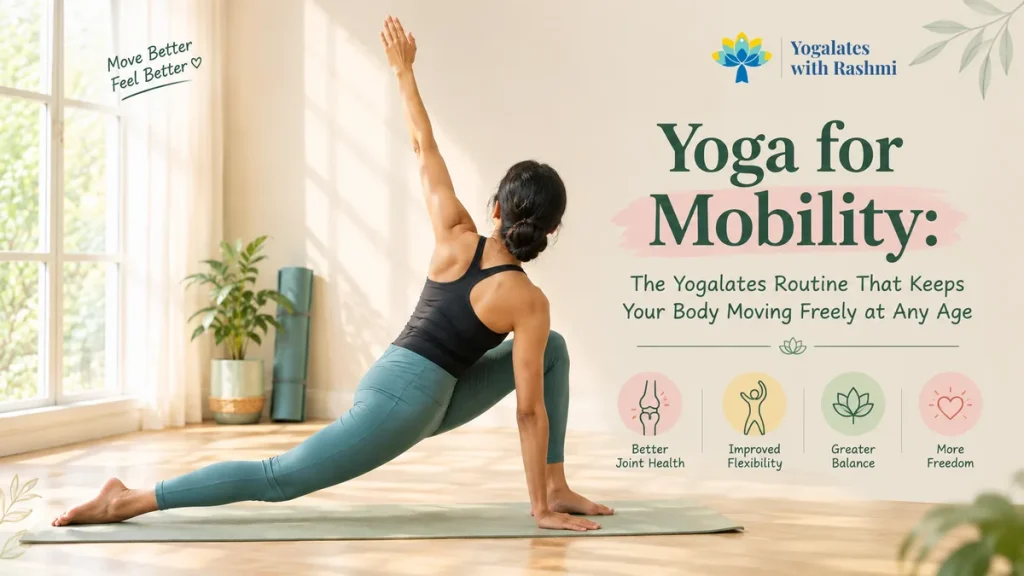
You bend down to pick up your child’s shoe and feel your lower back protest. You turn to reverse the car and your neck says no. You sit cross-legged on the floor at a family function and need a hand to get back up. None of this means you are “getting old”. It means your body is losing mobility, and the good news is that mobility can be trained back at any age. In this guide, I’ll show you how yoga for mobility works and share the exact 15-minute Yogalates routine I teach my students to keep their joints moving freely.
Mobility vs flexibility: why yoga for mobility is different
People often use the two words as if they mean the same thing. They don’t.
- Flexibility is how far a muscle can lengthen when something pulls it, like when you hold a forward fold and gravity does the work.
- Mobility is how far you can actively move a joint through its range, with control, using your own strength.
Flexibility is passive; mobility is active. You can be quite flexible and still have poor mobility if the muscles around the joint are too weak to control the movement. That is why so many people who stretch every day still feel stiff when they actually have to move.
Yogalates works on both. The Yoga part opens the range; the Pilates part builds the strength and control to own that range.
Why we lose mobility (and why it's not just age)
Of course, age plays a part. In fact, how we live plays a bigger one. The most common reasons I see in my students are:
- Sitting for long hours. Hours at a desk or in the car keep the hips bent and the upper back rounded, so the body slowly adapts to that shape.
- Doing the same movements every day. Walking and household work are good, but they rarely take the hips, spine or shoulders through their full range.
- Lifestyle changes for women. Pregnancy, postpartum recovery and the hormonal shifts of perimenopause can all change how joints and connective tissue feel.
- Fear of pain. When something hurts, we move it less, which makes it stiffer, which makes us move it even less.
The pattern is simple: the range you don’t use, you slowly lose. However, the fix is just as simple: use it, regularly and gently. That’s exactly what yoga for mobility does.
The benefits of yoga for mobility
Research backs up what Yoga teachers have seen for years. A 2019 review of randomised controlled trials in older adults found that yoga improved lower-body flexibility, balance and leg strength compared with doing no exercise (Sivaramakrishnan et al., 2019). The World Health Organization also recommends that older adults do varied activity that focuses on functional balance and strength on at least three days a week to help prevent falls (WHO recommendations).
In everyday life, better mobility means:
- Getting up from the floor without using your hands.
- Turning your head and upper body easily while driving.
- Reaching overhead shelves without strain on your shoulders.
- Less stiffness when you wake up in the morning.
- Better posture after a long day at your desk.
- More confidence and better balance on stairs and uneven roads.
The 15-minute Yogalates routine: yoga for mobility at home
First, roll out a yoga mat and practise barefoot, 4 to 5 times a week. Move slowly, breathe through your nose, and stay in a range that feels like a gentle stretch, never sharp pain. Mornings work beautifully, but any time of day is fine.
1. Neck and shoulder rolls (1 minute). Sit tall. Slowly roll your shoulders backwards 5 times, then forwards 5 times. Then gently tilt your ear towards each shoulder, holding for 3 breaths on each side.
2. Cat–Cow (Marjaryasana–Bitilasana) (1.5 minutes). On hands and knees, inhale as you lift your chest and tailbone, exhale as you round your back and tuck your chin. Repeat 8 to 10 times, moving one vertebra at a time.
3. Thread the needle (2 minutes). From hands and knees, slide your right arm under your left, resting your right shoulder and temple on the mat. Hold for 5 breaths, then open the right arm up to the ceiling. Repeat 4 times each side. This frees the upper back, one of the stiffest areas for desk workers.
4. Low lunge with a twist (Anjaneyasana variation) (2 minutes). Step your right foot forward into a lunge with your back knee down. Sink your hips forward to open the front of the left hip. Then place your left hand on the floor and turn your chest and right arm up. Hold for 5 breaths each side.
5. 90/90 hip switches (2 minutes). Sit with both knees bent at 90 degrees, one leg in front and one to the side. Keeping your chest tall, slowly rotate both knees to the other side. Repeat 8 times each way. Use your hands behind you for support if needed.
6. Pilates spine twist (1.5 minutes). Sit tall with your legs stretched out and arms out to the sides. Exhale and twist from the waist to one side, pulsing gently twice, then come back to centre. Repeat 6 times each side. Keep your hips still and your belly drawn in.
7. Supported deep squat (Malasana) (1.5 minutes). Feet wider than hips, toes turned out. Lower your hips towards the floor, using a block or folded blanket under your seat if your heels lift. Press your elbows into your knees and lengthen your spine. Hold for 5 to 8 breaths, rest, and repeat.
8. Downward dog with leg pedals (1.5 minutes). From hands and knees, lift your hips up and back. Bend one knee, then the other, pedalling your feet to wake up the calves and ankles. Keep your knees soft if your hamstrings are tight.
9. Bridge with arm reach (1 minute). Lie on your back with your knees bent. As you inhale, lift your hips and reach your arms overhead to the floor. Exhale and roll down one vertebra at a time. Repeat 8 times.
10. Reclined twist and rest (1 minute). Hug your knees in, then let them fall to one side while your arms open wide. Take 5 slow breaths each side. Finish lying still for a few breaths.
Yoga for mobility tips for every age
- In your 20s and 30s: Build the habit now. Pair this routine with strength work; my guide on strength training vs yoga explains why women benefit from both.
- In your 40s and 50s: Focus on hips, upper back and balance. Hormonal changes can make joints feel stiffer, so consistency matters more than intensity. My guide to yoga for hormonal health is a helpful next read.
- 60 and beyond: Use a chair or wall for support whenever you need it. You’ll find gentler options in my chair yoga for senior citizens guide.
- If you work at a desk: Break up your sitting time with these 5-minute Yogalates micro-workouts.
- If you are new: Read how many times a week beginners should do yoga or Pilates before you start.
Common mistakes to avoid when you practise yoga for mobility
- Forcing the stretch. Mobility improves through gentle, repeated movement, not by pushing into pain.
- Holding your breath. Slow nasal breathing relaxes the nervous system and lets muscles release.
- Only stretching, never strengthening. Without strength, new range doesn’t stay. That is why Yogalates combines both.
- Doing it once a week. Short daily sessions beat one long weekly session.
- Skipping warm-up on cold mornings. Start with the gentle neck, shoulder and Cat–Cow moves before deeper poses.
Practise yoga for mobility with me
If you’d like a structured plan with full video guidance, my Beginner Yogalates Course builds strength, flexibility and mobility over 28 days, with just a mat and 60 minutes a day. If you prefer to start smaller, the 21 Days Yogalates Challenge is a gentle way in. Not sure which suits you? Take the 60-second course quiz. You can also follow free classes on my YouTube channel.
Mobility isn’t about touching your toes or doing the splits. It’s about getting up from the floor, reaching, turning and bending without a second thought, today and in 20 years. Start with 15 minutes of yoga for mobility, a few times a week, and let your body remember how good it feels to move freely.
This article is for general information. If you have an injury, joint condition or recent surgery, please check with your doctor or physiotherapist before starting a new exercise routine.
Frequently asked questions about yoga for mobility
Q1. Is yoga good for mobility?
Yes. Yoga takes your joints through their full range in a slow, controlled way. Combined with Pilates-style strength work, as in Yogalates, it improves both how far you can move and how well you control that movement.
Q2. What is the difference between mobility and flexibility?
Flexibility is how far a muscle can stretch when something pulls it. Mobility is how far you can actively move a joint with your own strength and control. Good mobility needs both flexibility and strength.
Q3. How often should I do yoga for mobility?
Four to five short sessions a week of 10 to 15 minutes work better than one long session. Most people feel less stiff within two to three weeks of regular practice.
Q4. Can I improve my mobility after 40 or 50?
Yes. Mobility responds to regular movement at any age. Start gently, use props such as a block, chair or wall, and focus on your hips, upper back and balance.
Q5. What is the best time of day for a mobility routine?
Morning practice helps reduce stiffness after sleep, while an evening session can undo the effects of a long day of sitting. The best time is the one you can do consistently.
Q6. Is this mobility routine safe for beginners?
Yes. Every move can be made smaller or supported with props. Move slowly, never push into sharp pain, and check with your doctor first if you have an injury or a joint condition.