

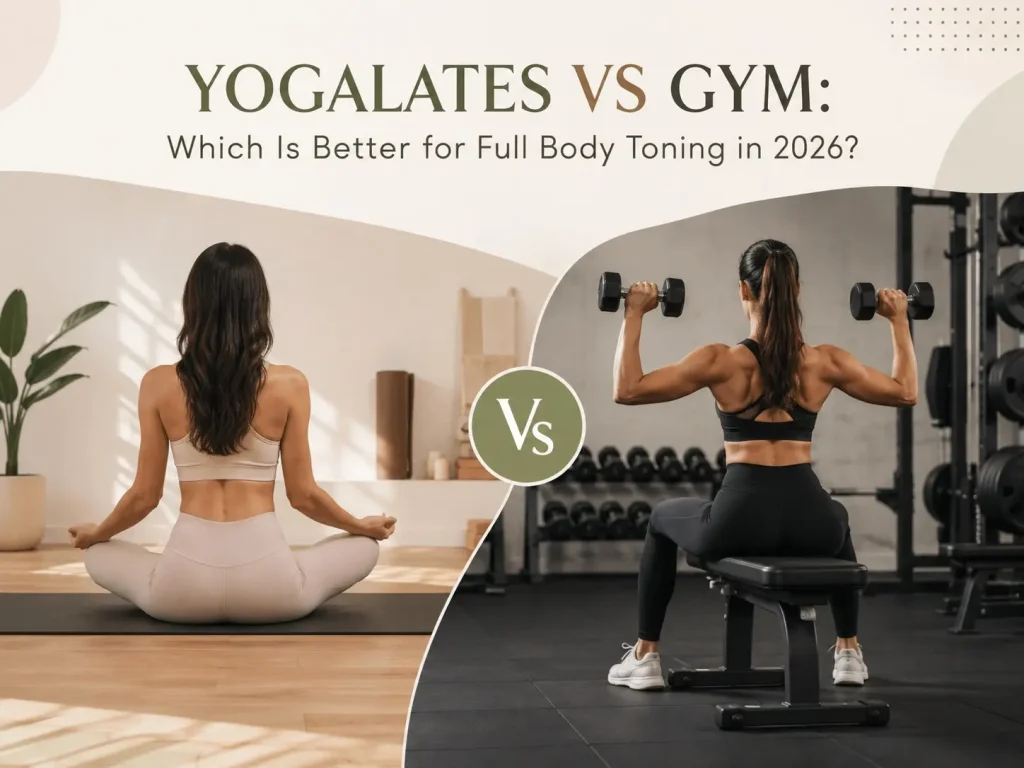
This is genuinely one of the most common questions people ask when they are considering Yogalates for the first time — especially if they have a gym background and wonder whether yoga-based training can deliver comparable or better physical results.
The honest answer is: it depends entirely on what you are training for. And once you understand what each approach actually does to the body, most people find the answer is surprisingly clear for their specific goals.
This is a real comparison — not a sales pitch for either option. Let us look at the evidence.
What the Gym Does Well
A gym — particularly strength training — is exceptionally effective for:
- Building maximum muscle mass (hypertrophy) through progressive overload with heavy weights
- High-calorie burn through high-intensity cardio and circuit training
- Sport-specific performance training
- Building bone density through heavy loading
If your goal is to be a competitive powerlifter, a bodybuilder, or to train for a specific athletic event, the gym provides tools that Yogalates cannot replicate.
What Yogalates Does Better Than the Gym
For the majority of people whose goals are health, sustainable fitness, body toning, stress management, and looking and feeling better long-term — Yogalates wins on nearly every relevant dimension:
Functional Strength You Actually Use
This is perhaps the starkest difference. Conventional gym training — particularly heavy lifting without adequate stretching — consistently reduces flexibility over time. Yogalates builds flexibility and mobility as a core component of every session. The result is a body that is simultaneously stronger and more mobile — a combination that gym training alone rarely achieves.
Mental Health Benefits
In 2026, mental wellness is one of the main reasons people exercise — as daily life becomes faster and more digitally saturated, yoga is increasingly valued as a way to slow down, regulate stress, and reset. A gym session does not offer this. Yogalates does — through breathwork, mindful movement, and the parasympathetic activation that every session produces.
No Equipment, No Commute, No Schedule
The practical advantages of Yogalates matter enormously for long-term consistency. The Intermediate Yogalates Course, Sweat & Burn Course, and 12 Week Fitness Project require a mat and a small space. No membership fees, no travel time, no class schedules. The barrier to showing up is dramatically lower — which is why Yogalates students practice more consistently than gym members on average.
Injury Risk
Gym training — particularly without expert form coaching — carries meaningful injury risk, especially to the lower back, knees, and shoulders. Yogalates, with its emphasis on controlled movement, breath awareness, and progressive loading, has a significantly lower injury profile. This is especially relevant for anyone returning to fitness after a break, dealing with existing joint issues, or in postnatal recovery.
Head-to-Head Comparison
Factor | Gym | Yogalates |
Muscle building (max mass) | Superior | Moderate |
Full body toning | Good | Superior |
Flexibility and mobility | Often reduces | Core benefit |
Stress relief | Can increase | Core benefit |
Injury risk | Higher | Lower |
Equipment required | Yes | No |
Suitable for postnatal | Risky | Specifically designed |
Long-term sustainability | Medium | High |
Mental health benefits | Limited | Significant |
Cost | Monthly fees | One-time course |
The Verdict — And Who Should Choose What
Choose Yogalates if: You want sustainable full-body toning, flexibility, core strength, stress relief, and a practice you can maintain for years without equipment, injury risk, or commuting. The Beginner Yogalates Course or 12 Week Fitness Project is your starting point.
Choose the gym if: Your specific goal is maximum muscle hypertrophy or sport-specific performance training, and you already have strong functional movement foundations.
Choose both if: You use the gym for heavy compound lifting and Yogalates for mobility, recovery, flexibility, and stress management. This combination is genuinely powerful and increasingly popular among serious fitness practitioners.
For the vast majority of people reading this — particularly women in India looking to tone their body, manage stress, and build a sustainable fitness practice they will actually maintain for years — Yogalates is the clearer, more practical, and more complete choice.
Related Reading
FAQs — Yogalates vs Gym
Q1: Can Yogalates replace the gym?
For most people whose goals are toning, flexibility, core strength, and overall fitness — yes, Yogalates fully replaces the gym. For goals specifically requiring maximum muscle mass or sport-specific training, the gym provides tools Yogalates does not.
Q2: Is Yogalates better than gym for women?
For most women’s goals — toning, core strength, stress relief, flexibility, postnatal recovery, and sustainable long-term fitness — Yogalates is significantly more complete than gym training alone. It addresses the physical, hormonal, and mental dimensions of women’s health simultaneously.
Q3: How long does Yogalates take to show results compared to the gym?
Both approaches show initial results in 4 to 8 weeks. Gym training may produce faster visible muscle bulk. Yogalates produces faster functional strength, flexibility, posture, and mental wellbeing improvements — and the results are typically more sustainable long-term because the practice is more enjoyable and requires no external facility.