

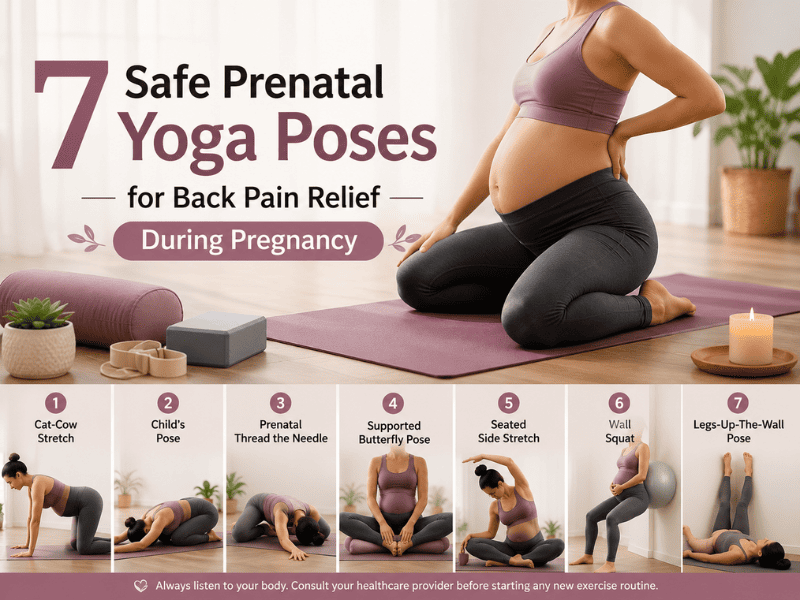
If there is one physical complaint that unites expecting mothers across every trimester, every body type, and every pregnancy experience — it is back pain. Studies suggest that up to 80 percent of pregnant women experience some form of back pain during pregnancy, making it one of the most common and most disruptive pregnancy discomforts of all.
And yet, despite how universal it is, most pregnant women are never given practical, specific guidance on what to actually do about it. “Rest more” and “use a pregnancy pillow” are well-meaning suggestions — but they do not address the underlying physical causes that make pregnancy-related back pain so persistent.
Prenatal yoga poses for back pain do. Specifically, the combination of yoga and Yogalates taught by Rashmi Ramesh — India’s leading Yogalates educator — targets the exact muscles, joints, and movement patterns that pregnancy affects most. The result is genuine, measurable back pain relief that is safe for you and your baby at every stage.
In this guide, you will find the 7 safest and most effective prenatal yoga poses for back pain during pregnancy — with clear instructions for every trimester, the science behind why each pose works, and the poses and movements to avoid entirely.
Important: Always consult your doctor or midwife before beginning any exercise programme during pregnancy. The poses in this guide are appropriate for uncomplicated pregnancies with no contraindications. If you experience sharp pain, dizziness, or any unusual symptoms during practice, stop immediately and seek medical advice.
Why Does Back Pain Happen During Pregnancy?
Understanding the cause is the first step to addressing it properly — and it also explains why the right yoga poses work so well.
Postural Changes and Shifted Centre of Gravity
As the baby grows, the uterus moves forward, shifting the body’s centre of gravity. To compensate, the lower back curves inward more than usual — a posture called anterior pelvic tilt. This compresses the lumbar spine, strains the erector spinae muscles along the back, and creates the familiar aching pain in the lower back that worsens as pregnancy progresses.
Relaxin and Loose Ligaments
Pregnancy triggers the release of relaxin — a hormone that softens and loosens the ligaments throughout the pelvis and spine in preparation for birth. While necessary, this loosening reduces the stability of the sacroiliac joint and pubic symphysis, making the pelvis more vulnerable to strain from everyday movement. This ligament laxity is why back pain often worsens in the second and third trimesters.
Weakened Core Muscle
As the abdomen expands, the deep core muscles — particularly the transverse abdominis — become increasingly stretched and less able to provide their normal stabilising function for the spine. A less supported spine is a more painful spine.
Tight Hip Flexors and Piriformis
The psoas muscle and hip flexors — already prone to tightening from sitting — are further compressed by the growing bump, pulling the lower spine forward. Additionally, the sciatic nerve, which runs through the piriformis muscle deep in the glutes, can become irritated as the pelvis widens and postural alignment shifts — causing the radiating pain down the leg known as sciatica.
Prenatal yoga addresses every one of these mechanisms directly. As a result, research shows that prenatal gentle yoga significantly reduces lower back pain in pregnant women, with average pain scores dropping from 6.17 before practice to 3.25 after just two weeks of intervention.
7 Safe Prenatal Yoga Poses for Back Pain Relief
These poses have been selected specifically for their safety profile during pregnancy and their targeted effectiveness for the causes of pregnancy back pain described above.
Pose 1 — Cat-Cow (Marjaryasana-Bitilasana)
Trimesters safe for: All three trimesters Targets: Lumbar spine, thoracic spine, deep spinal muscles
Why it works: Cat-Cow is one of the most universally recommended prenatal yoga poses — and for good reason. The rhythmic flexion and extension of the spine mobilises every vertebra, releases the erector spinae muscles that tighten with the extra lumbar curve of pregnancy, and stimulates the synovial fluid that lubricates the spinal joints. Furthermore, the position itself takes gravitational load off the lower back, providing immediate relief from the compression that upright posture creates throughout the day.
How to practice: Come onto hands and knees in a tabletop position — wrists under shoulders, knees under hips. As you inhale, drop the belly gently toward the mat, lift the gaze and tailbone (Cow). As you exhale, round the spine toward the ceiling, tuck the chin and tailbone (Cat). Let the breath lead the movement — the spine follows. Move through 8 to 10 slow, conscious rounds.
Modification for third trimester: Reduce the depth of the belly drop in Cow to avoid overstretching the already lengthened abdominal wall. Keep the movement gentle and breath-led rather than working for maximum range.
Pose 2 — Child's Pose (Balasana) — Wide-Knee Variation
Trimesters safe for: All three trimesters (with modification) Targets: Lower back, hips, thoracic spine, sacroiliac joint
Why it works: Wide-knee Child’s Pose creates a gentle traction effect on the lower back by lengthening the lumbar spine while taking all load and compression off it entirely. The forward fold stretches the erector spinae, releases tension in the sacroiliac joint, and creates the gentle abdominal pressure that many students find calming — activating the vagus nerve and promoting parasympathetic relaxation. This is also one of the most effective positions for sciatica relief because it opens the external rotators of the hip without compressing the sciatic nerve.
How to practice: From tabletop, bring the knees wide apart — wider than hip-width — to create space for the growing bump. Sit the hips back toward the heels (they need not touch). Walk the hands forward and rest the forehead on the mat or a folded blanket. Hold for 8 to 10 slow breaths, feeling the back lengthen with every exhale.
Modification: Place a folded blanket under the forehead for support. In the third trimester, a bolster or rolled blanket between the thighs and torso provides additional support and comfort.
Pose 3 — Thread the Needle (Parsva Balasana)
Trimesters safe for: All three trimesters Targets: Thoracic spine, upper back, shoulders, piriformis
Why it works: Thread the Needle provides a gentle rotation through the thoracic spine — the mid-back — which is often significantly compressed by the rounded shoulder posture of pregnancy. It also stretches the piriformis and external hip rotators, which, when tight, directly compress the sciatic nerve and contribute to radiating pain down the leg. Moreover, this is one of the only safe spinal rotation poses during pregnancy, as it rotates the thoracic spine without twisting the lumbar spine or abdominal region.
How to practice: From tabletop, slide the right arm under the left arm, palm facing up, until the right shoulder and right temple rest on the mat. The left hand stays planted, or reaches overhead for a deeper stretch. Hold for 5 to 8 breaths. Return to tabletop and repeat on the left side.
Pose 4 — Supported Bridge Pose (Setu Bandha Sarvangasana — Modified)
Trimesters safe for: First and second trimester only Targets: Glutes, hamstrings, lower back, pelvic floor
Why it works: The gluteus maximus and hamstrings are the primary stabilisers of the pelvis from behind. When these muscles are weak — which desk work and pregnancy both contribute to — the lower back compensates by over-working, leading to strain and pain. Supported Bridge Pose reactivates the glutes and hamstrings in a safe, controlled way, directly reducing the load placed on the lumbar spine.
Additionally, the gentle pelvic tilt of Bridge Pose decompresses the lumbar vertebrae and provides the kind of active traction that passive stretching alone cannot.
How to practice: Lie on your back with knees bent, feet hip-width apart and flat on the mat. Gently engage the pelvic floor. Press through the feet and slowly lift the hips toward the ceiling — no need to go high. Hold for 3 breaths, then lower slowly. Repeat 8 times.
Modification and important note: Bridge Pose on the back is safe in the first and second trimesters. After 20 weeks, avoid lying flat on your back for extended periods. You can prop the upper back on a folded blanket to maintain a slight incline. In the third trimester, replace Bridge with a supported standing squat against the wall.
Pose 5 — Standing Forward Fold with Support (Uttanasana — Supported)
Trimesters safe for: All three trimesters (with support) Targets: Hamstrings, lower back, spinal erectors
Why it works: Tight hamstrings directly pull on the sitting bones and tilt the pelvis, contributing to lower back strain. A supported Standing Forward Fold lengthens the hamstrings without creating compression — instead, the gentle inversion creates traction through the entire spine, providing decompression and relief. Furthermore, the forward fold position stimulates the parasympathetic nervous system, reducing the cortisol and muscle tension that amplify pain perception.
How to practice: Stand hip-width apart in front of a chair or wall. Place your hands on the chair seat or wall. Soften the knees generously. Let the torso hang forward from the hips, allowing the lower back to lengthen. Breathe slowly and feel the spine decompress with each exhale. Hold for 6 to 8 breaths.
Modification for third trimester: Keep the bend in the knees deeper and rest the forearms on the chair back for additional support. Avoid unsupported forward folds in late pregnancy when balance is significantly affected.
Pose 6 — Pigeon Pose — Supported Variation (Eka Pada Rajakapotasana)
Trimesters safe for: First and second trimester primarily; modified in third Targets: Piriformis, hip rotators, sciatic nerve, glutes
Why it works: Pigeon Pose is one of the most targeted poses for pregnancy-related sciatica and deep gluteal tension. The piriformis muscle, when tight, directly compresses the sciatic nerve — producing the radiating pain, numbness, and tingling down the leg that many pregnant women experience. Pigeon Pose stretches the piriformis more effectively than almost any other yoga pose, often producing immediate relief from sciatic symptoms.
How to practice: From tabletop, bring the right knee toward the right wrist, allowing the right foot to move toward the left hand. Slide the left leg back, keeping the hips square. Support the right hip with a folded blanket if it does not comfortably reach the mat. Stay upright — do not fold forward in pregnancy. Hold for 6 to 8 breaths, then repeat on the left side.
Modification for third trimester: Use a seated Pigeon variation in a chair: sit upright, place the right ankle on the left thigh just above the knee, flex the right foot, and allow the right knee to drop gently. This provides the same piriformis stretch with full back support.
Pose 7 — Supine Twist — Modified (Supta Matsyendrasana — Prenatal)
Trimesters safe for: First trimester only (see modification for second and third) Targets: Thoracic spine, paraspinal muscles, SI joint
Why it works: The paraspinal muscles — running along both sides of the spine — chronically tighten in pregnancy as they work to stabilise an increasingly front-heavy torso. A gentle spinal twist releases this tension and mobilises the thoracic spine, providing significant relief from mid and upper back pain. The sacroiliac joint — a primary site of pregnancy-related back pain — also benefits from the gentle rotational movement.
How to practice (First trimester): Lie on your back with knees bent. Drop both knees to the right while looking left. Keep both shoulders on the mat. Hold 5 breaths, then return to centre and repeat on the left side.
Modification for second and third trimesters: Replace the supine twist with a seated twist: sit cross-legged or in a chair. On an inhale, lengthen the spine. On the exhale, rotate gently to the right from the thoracic spine only — do not twist through the lumbar spine or pull on the belly. Keep the navel facing forward and only the chest and shoulders rotating. Hold 3 breaths per side. This safely provides thoracic mobility without any compression of the abdomen.
Yoga Poses to Avoid During Pregnancy
Knowing what not to do is as important as knowing what to practise. Avoid the following during pregnancy:
Deep backbends (Wheel, Camel, Bow) — create excessive lumbar compression and stretch the already over-lengthened abdominal wall.
Deep twists through the abdomen — compress the uterus and should be replaced with the thoracic-only seated twist described above.
Inversions (Headstand, Shoulderstand) — risk of falls and haemodynamic changes are not appropriate during pregnancy.
Prone poses lying face down — uncomfortable and potentially unsafe from the second trimester onward as the bump grows.
Lying flat on the back for extended periods after 20 weeks — can compress the vena cava, reducing blood flow to the baby.
Hot yoga — elevated temperature during pregnancy is associated with adverse outcomes and should be avoided entirely.
Unsupported balancing poses — the shifted centre of gravity in pregnancy significantly increases fall risk in single-leg balance positions.
How to Build a Safe Prenatal Yoga Routine for Back Pain
Practicing these 7 poses consistently — 4 to 5 times per week for 20 to 30 minutes — produces measurable reduction in pregnancy back pain within 2 to 3 weeks. Here is a simple daily sequence:
| Order | Pose | Duration |
|---|---|---|
| 1 | Cat-Cow | 2 min (10 rounds) |
| 2 | Wide-knee Child’s Pose | 2 min |
| 3 | Thread the Needle | 1.5 min (each side) |
| 4 | Supported Bridge (1st/2nd trimester) or Wall Squat (3rd) | 2 min |
| 5 | Supported Standing Forward Fold | 2 min |
| 6 | Supported Pigeon or Chair Pigeon | 2 min (each side) |
| 7 | Seated Thoracic Twist | 1.5 min (each side) |
| 8 | Savasana in left side-lying position | 3 min |
Total time: approximately 20 minutes. This is the foundation of what is taught in the Prenatal Yoga Course by Rashmi Ramesh — structured, progressive, and safe for all three trimesters.
Why a Structured Prenatal Yoga Course Is Better Than Practicing Alone
Practicing individual poses from a guide like this one is a good starting point. However, a structured prenatal yoga course delivers significantly better and safer results for three important reasons.
Expert guidance ensures correct technique. Many of the modifications that make yoga safe in pregnancy are subtle — the difference between a safe seated twist and one that compresses the uterus is in the execution, not just the pose itself. Without expert instruction, it is easy to practice in ways that look correct but are not.
Trimester-specific progression matters. What is appropriate and beneficial in the first trimester is different from what is appropriate in the third. A structured course accounts for this automatically — you do not need to research what to avoid at each stage.
Breathwork and labour preparation are built in. The 7 poses in this guide address back pain. A complete prenatal yoga course also builds the breathing techniques, pelvic floor awareness, and mental tools for labour that are equally important — and that isolated pose guides rarely cover.
The Prenatal Yoga Course by Rashmi Ramesh is trimester-by-trimester, fully online with lifetime access, and covers back pain, pelvic floor, labour preparation, and complete prenatal wellbeing in one structured programme.
For the most complete pregnancy and postnatal journey, the Beyond the Bump Masterclass covers the entire arc from pregnancy through postnatal recovery.
After delivery, the Postnatal Yogalates Course picks up where prenatal practice ends — rebuilding pelvic floor, core, and full body fitness safely after birth.
Related Reading
- Postnatal Yoga Course Online for New Mothers
- The Best Mother’s Day Yoga Self-Care Routine for Mums
- Cortisol Detox: Can Yoga Really Reduce Stress Hormones?
- Yoga for Better Sleep: Night Routine That Works Naturally
- Morning vs Evening Yoga in Summer: What’s Better for Your Body?
Courses for expecting mothers:
Frequently Asked Questions — Prenatal Yoga for Back Pain
Q1; Is prenatal yoga safe for back pain during pregnancy?
Yes — prenatal yoga is one of the most widely recommended interventions for pregnancy-related back pain. Research consistently shows that gentle prenatal yoga reduces lower back pain significantly in pregnant women. The key is choosing poses that are specifically appropriate for pregnancy — avoiding deep backbends, supine positions in later trimesters, and unsupported inversions. Always get your healthcare provider’s clearance before beginning.
Q2; Which trimester is back pain worst in pregnancy?
Back pain is most common and typically most intense in the second and third trimesters, as the growing bump shifts the centre of gravity further forward, relaxin loosens spinal ligaments, and the core muscles become increasingly stretched and less able to stabilise the spine. However, some women experience early lower back discomfort in the first trimester due to hormonal changes. The 7 poses in this guide include trimester-specific modifications for each stage.
Q3; Can prenatal yoga help with sciatica during pregnancy?
Yes. Pregnancy-related sciatica — caused by the sciatic nerve being compressed or irritated as the pelvis widens and postural alignment shifts — responds well to targeted yoga. Supported Pigeon Pose, wide-knee Child’s Pose, and Thread the Needle are particularly effective for piriformis release, which directly relieves sciatic compression. Many women experience noticeable relief from sciatica within 1 to 2 weeks of consistent practice.
Q4; How often should I do prenatal yoga for back pain relief?
Practicing 4 to 5 times per week for 20 to 30 minutes produces the best results for pregnancy back pain. Consistency matters more than session length — short, regular practice maintains the flexibility and muscle activation that prevents pain from returning. Even 15 minutes of the Cat-Cow, Child’s Pose, and Thread the Needle sequence daily produces measurable relief within 2 weeks.
Q5; What yoga poses should I avoid during pregnancy?
Avoid deep backbends (Wheel, Camel, Bow Pose), deep abdominal twists, full inversions (Headstand, Shoulderstand), prone poses (lying on the stomach), hot yoga, and unsupported balancing poses. After 20 weeks, avoid lying flat on your back for extended periods as this can compress the vena cava and reduce blood flow to the baby. Always choose pregnancy-specific modifications and ideally practice with a qualified prenatal yoga instructor.
Q6; When should I stop prenatal yoga if I have back pain?
Stop immediately and contact your healthcare provider if you experience sharp or sudden back pain, pain that radiates down the leg with numbness or tingling that has not been assessed by a doctor, any abdominal cramping or contractions during practice, dizziness, shortness of breath, or any unusual discharge. Normal pregnancy back pain that gradually improves with gentle movement is what these poses are designed for — not acute or severe symptoms that require medical evaluation.