

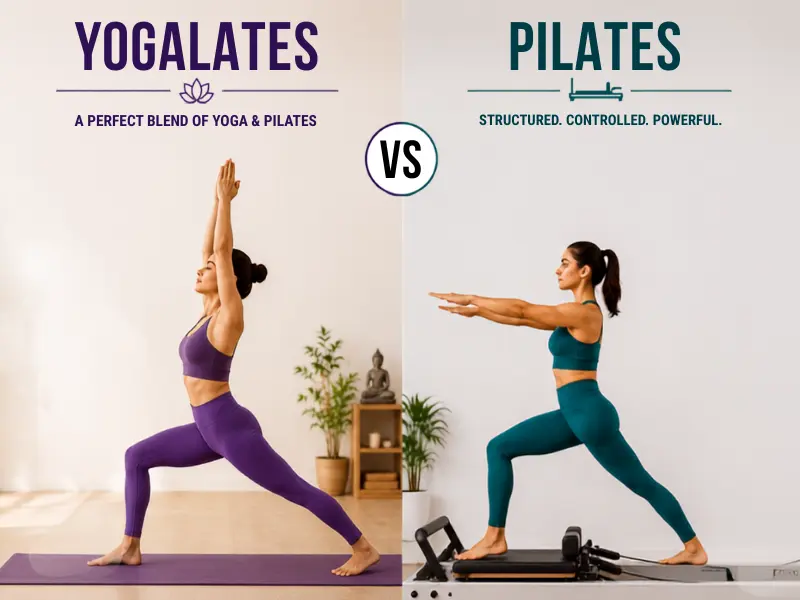
Yogalates is a hybrid workout that blends the flexibility, breathwork, and mindfulness of yoga with the core strengthening, muscle-toning discipline of Pilates — giving you both benefits in a single session. Pilates alone focuses on controlled core and muscle work, while yoga alone focuses on flexibility and breath. Yogalates combine the two, so you don’t have to choose one over the other.
If you’ve ever finished a Pilates class feeling strong but stiff, or a yoga class feeling calm but not challenged, you already understand why this question matters. Let’s break down exactly what separates the two — and which one actually fits your goals.
In 15 years of teaching, the #1 mistake I see beginners make is picking a side too early. Someone tries one Pilates class, decides they’re “not flexible enough” for it, and gives up. Or they try a yoga class, feel like it’s “too slow” to build real strength, and switch to something more intense. Both reactions come from the same misunderstanding — that you have to choose one system and live with its gaps. You don’t. — Rashmi
What Is Pilates?
Pilates was developed in the early 20th century by Joseph Pilates as a system of controlled, low impact movements designed to build deep core strength, improve posture, and correct muscular imbalances. A typical Pilates session — whether on a mat or a reformer machine — emphasizes:
- Precise, slow, controlled movement
- Deep core and pelvic floor activation
- Muscular endurance over flexibility
- Minimal spiritual or meditative element
It’s an excellent system for building stability and strength, especially for people recovering from injury or dealing with desk-job posture problems. But Pilates on its own does very little for flexibility, breath control, or nervous system regulation.
What Is Yoga?
Yoga is a much older practice rooted in breath, flexibility, and mind body awareness. Depending on the style, a yoga session can range from an athletic Vinyasa flow to a slow, meditative Restorative class. Its core focus areas are:
- Flexibility and joint mobility
- Breath awareness (pranayama)
- Balance and body awareness
- Mental calm and stress reduction
Yoga builds a supple, adaptable body and a regulated nervous system — but traditional yoga alone doesn’t build the same targeted core strength or muscular endurance that Pilates does.
What Is Yogalates? The Best of Both
Yogalates takes the core-strengthening precision of Pilates and layers it with the flexibility, breathwork, and mindfulness of yoga. Instead of picking one discipline and missing out on the other, you get a single, complete practice that:
- Builds core strength and full-body flexibility in the same session
- Combines breathwork with muscular endurance training
- Improves posture from both the “stability” side (Pilates) and the “mobility” side (yoga)
- Calms the nervous system while still delivering a real physical challenge
This is exactly the kind of fusion training that’s becoming one of the biggest wellness trends of 2026, as more people move away from extreme, all-or-nothing workouts and toward sustainable, longevity-focused fitness.
The research backs this up, too. A workplace-based study published in a peer-reviewed exercise science journal followed office employees through a four-month program that combined yoga and Pilates-style training, and found measurable improvements in flexibility, balance, and strength — alongside high enjoyment scores, which mattered just as much for whether people actually stuck with it. That last part is the piece most single-discipline programs miss: a workout only works if you keep showing up for it.
Yogalates vs Pilates: Side-by-Side Comparison
Feature | Pilates | Yoga | Yogalates |
Core strength focus | High | Low-Moderate | High |
Flexibility focus | Low | High | High |
Breathwork | Minimal | Central | Central |
Nervous system regulation | Low | High | High |
Equipment needed | Often a reformer machine | Just a mat | Just a mat |
Beginner-friendly | Yes | Yes | Yes |
Best for | Targeted strength, rehab | Stress relief, mobility | All-round strength & calm |
Which One Should You Choose?
1. If you're a complete beginner
Start with something structured that builds strength and flexibility together, rather than learning two separate systems. The Beginner Yogalates Course is built exactly for this — no prior yoga or Pilates experience needed, with step-by-step guidance from the very first session.
2. If you want a short daily habit
If your goal is consistency over intensity, the 21 Days Yogalates Challenge gives you 21-minute daily sessions with 6 months of access, so you can build the habit without it eating your whole day.
3. If you're pregnant or postpartum
Neither classic Pilates nor classic yoga alone is designed with pregnancy-specific safety in mind. This is where a dedicated, trimester-aware program matters — explore the prenatal and postnatal programs on the Yogalates with Rashmi courses page for guidance built specifically for this stage of life.
4. If you want visible, full-body results
For a longer, progressive transformation, the 12 Weeks Yogalates Fitness Project or the Twist & Tone 2 Months Program build strength, flexibility, and toning progressively, week by week, rather than relying on one-off intense sessions.
Common Mistakes When Switching from Pilates to Yogalates
If you’re coming from a Pilates background and trying Yogalates for the first time, a few habits tend to trip people up. I see these constantly with new students, so it’s worth naming them upfront.
- Holding your breath during core work; Pilates trains you to brace and control, which is great, but it can turn into breath-holding under effort. Yogalates asks you to keep breathing through the hard parts — that’s actually the point. If you notice you’re holding your breath during a plank or a twist, that’s your cue to slow down, not push harder.
- Rushing through the stretches; Pilates movements are precise but usually brisk. When a Yogalates class slows down into a longer hold, it can feel like “wasted time” if you’re used to constant movement. It isn’t. That stillness is where the flexibility and nervous-system benefits actually happen — skipping it means you’re only getting half the workout.
- Expecting the same soreness pattern; Pilates soreness tends to show up sharply in the deep core and glutes. Yogalates soreness is more spread out, and softer, because you’re working mobility alongside strength. Don’t mistake “less intense burn” for “less effective” — the results just show up differently, usually as better posture and range of motion before they show up as visible toning.
- Skipping modifications because “I already do Pilates;” Prior Pilates experience helps with body awareness, but it doesn’t automatically translate to yoga-style balance and hip mobility. I’ve had strong, experienced Pilates clients struggle with a basic seated twist because their hips were tighter than they realized. Take the beginner modification the first few times, even if your core strength is already solid.
Why Yogalates Is a Smarter Choice in 2026
The biggest shift in fitness this year is away from “no pain, no gain” and toward sustainable, longevity focused movement. People are increasingly asking not “how hard can I train today” but “how well will my body move in 10, 20, or 30 years.” Pilates alone builds strength without flexibility. Yoga alone builds flexibility without targeted strength. Yogalates is built for exactly this longevity first mindset — strengthening the body while keeping it supple, and calming the nervous system while still delivering measurable physical progress.
How to Get Started with Yogalates
You don’t need a studio, a reformer machine, or years of experience to start. All you need is a mat, comfortable clothing, and 20–60 minutes, depending on which program you pick. I’ve taught this practice for over 15 years now, to more than 2.5 lakh students around the world, and every course I build is designed around the same idea: meet you exactly where you are, not where a generic program assumes you should be. Whether this is your very first workout ever or your comeback after a long break, there’s a starting point built for it.
Browse the full blog for more free guidance, or head straight to the course library to pick the program that matches your goal.
Frequently Asked Questions
Q1; Is Yogalates better than Pilates?
Neither is objectively “better” — they serve different goals. Pilates is more targeted toward pure core strength and muscular control, while Yogalates adds flexibility, breath work, and nervous system benefits on top of that same cor strengthening foundation, making it a more complete, full body practice for most people.
Q2; Can beginners do Yogalates, or is Pilates easier to start with?
Both are beginner-friendly, but Yogalates is often easier for total beginners because it teaches breath, alignment, and movement together from day one, rather than requiring you to separately learn Pilates form and yoga breathing. The Beginner Yogalates Course starts from the absolute basics.
Q3; Do I need a reformer machine for Yogalates?
No. Unlike studio Pilates, which often uses a reformer machine, Yogalates is designed to be done with just a yoga mat, making it fully accessible as a home workout.
Q4;How many days a week should I practice Yogalates?
For most people, 3–5 sessions a week is enough to see improvements in flexibility, posture, and strength within 4–6 weeks, provided sessions are consistent rather than sporadic. Shorter daily sessions, like the 21 Days Challenge, work well for building that consistency.
Q5; Is Yogalates safe during pregnancy or postpartum recovery?
Regular Pilates and regular yoga both need modification during pregnancy and postpartum recovery, and general classes aren’t always built with this in mind. Look for a program specifically designed for your trimester or recovery stage rather than a generic class — check the prenatal and postnatal options on the courses page for guidance built around this.
Note: Ready to try it for yourself? Start with the 21 Days Yogalates Challenge or explore the full course library to find the program that matches exactly where you are in your fitness journey.