

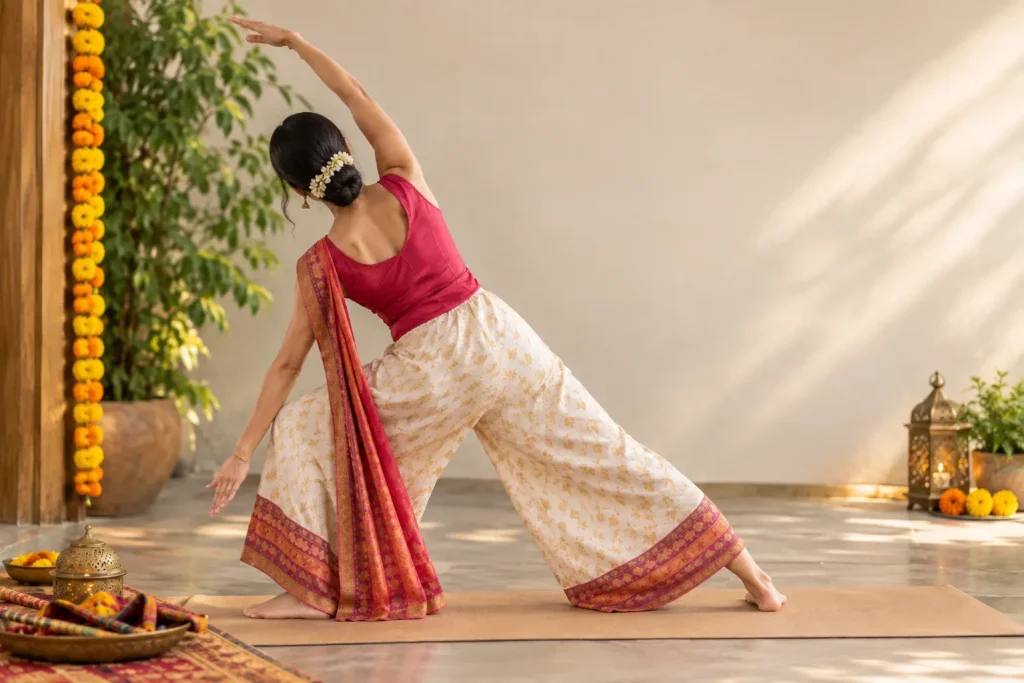
Quick answer: Yes, you can do yoga during a Navratri fast, as long as you keep it gentle, stay hydrated and match your practice to the type of fast you’re keeping. On fruit or phalahar fasts, 20 to 30 minutes of easy Yogalates is fine. On a nirjala (no-water) fast, stick to breathing and light stretching only. Before garba, a 15-minute warm-up protects your knees, calves and lower back.
Navratri 2026 begins on Sunday, October 11 and ends with Dussehra on Tuesday, October 20. For many of us, that means nine days of fasting by day and garba or dandiya by night. It’s joyful, but it’s also a lot to ask of your body.
Every year my students ask me the same two questions: “Should I stop my yoga practice while fasting?” and “Why do my knees and calves hurt so much after garba?” This guide answers both, so you can enjoy every night of Navratri and still feel strong on Dussehra.
Can you do yoga while fasting during Navratri?
Yes, and gentle movement can actually help you feel lighter and more energetic during a fast. The key is to lower the intensity. A fasting body has less fuel, so this isn’t the week for your hardest workouts.
Here’s how to match your practice to your fast:
Type of Navratri fast | What you eat | Recommended practice |
|---|---|---|
Phalahar fast | Fruit, milk, curd, sabudana, makhana, kuttu or rajgira | 20–30 minutes of gentle Yogalates, stretching and core work |
One meal a day (ekbhukt) | One sattvic meal, usually in the evening | 15–20 minutes of light yoga in the morning, no intense core or cardio |
Nirjala fast | No food or water | Breathing practice and gentle stretching only, no workouts |
If you feel dizzy, weak or light-headed at any point, stop, sit down and sip water or coconut water if your fast allows it.
When is the best time to practise during a Navratri fast?
- Early morning after a glass of water, when your energy is steadiest. My 10-minute morning Yogalates routine for energy is ideal for fasting days.
- 60 to 90 minutes after your phalahar meal, if mornings don’t work.
- About an hour before garba, for the warm-up below.
5 rules for a safe Navratri fasting workout
- Hydrate well. Drink water, coconut water, buttermilk or nimbu pani with sendha namak through the day, if your fast permits.
- Drop the intensity by half. Choose flowing, steady movement over fast-paced cardio.
- Eat protein from fasting foods. Paneer, curd, makhana, peanuts and rajgira help your muscles recover. For more ideas, read what to eat before and after Yogalates.
- Protect your sleep. Late garba nights and early pujas add up. Even 10 minutes of restorative yoga before bed helps.
- Listen to your body. Navratri is about devotion and joy, not personal bests.
The 15-minute garba-ready warm-up
Garba means hours of repetitive spinning, clapping and bending, often on hard floors. Cold muscles strain easily, and that’s why so many people wake up with sore calves, knees and lower backs. Do this warm-up before you head out.
1. Ankle rolls and calf raises (2 minutes)
Stand tall and roll each ankle 10 times in each direction. Then rise onto your toes and lower slowly, 15 times. This prepares your calves and ankles for hours on your feet.
2. Hip circles (2 minutes)
Place your hands on your hips and draw big, slow circles, 10 in each direction. This loosens the hips for all the twisting and turning in garba.
3. Cat–Cow (2 minutes)
On hands and knees, arch and round your spine with your breath. It warms the lower back, which takes the strain of every bend and clap.
4. Low lunge (2 minutes, 1 minute each side)
Step one foot forward and lower your back knee. Sink your hips gently forward. This opens the hip flexors and front thighs.
5. Glute bridge (2 minutes)
Lie on your back, knees bent, and lift and lower your hips slowly. Strong glutes take pressure off your knees while you dance.
6. Chair pose pulses (2 minutes)
Bend your knees as if sitting in a chair, keeping your knees behind your toes. Pulse gently up and down. This builds the thigh strength that supports your knees.
7. Standing side stretch (1 minute)
Reach your arms overhead and lean to each side for 3 breaths. It frees the waist and ribs so you can breathe deeply while dancing.
8. Garland squat, or Malasana (2 minutes)
Squat low with feet wide and palms together at your chest. Hold for a few breaths, rise, and repeat. It mobilises your hips, knees and ankles in one move.
The 5-minute post-garba cool-down
When you get home, spend five minutes on these before bed. Your legs will thank you in the morning.
- Legs up the wall (Viparita Karani), 2 minutes: eases tired, heavy legs and calms your nervous system.
- Supine twist, 1 minute: releases the lower back after hours of bending.
- Butterfly pose, 1 minute: gently opens the hips and inner thighs.
- Child’s pose with slow breathing, 1 minute: settles your mind for sleep.
For deeper rest through the festival, my Restore & Relax yoga and meditation course has calming sessions you can do in bed.
Your 9-day Navratri Yogalates plan
Keep it simple and consistent. Match each day’s practice to how your fast and garba schedule feel.
Day | Date | Colour | Focus | Practice |
|---|---|---|---|---|
1 | Oct 11 | Orange | Energy | 10-minute morning routine + garba warm-up |
2 | Oct 12 | White | Calm | Breathing practice + gentle stretches |
3 | Oct 13 | Red | Strength | Light core work + garba warm-up |
4 | Oct 14 | Royal Blue | Balance | Tree and Warrior poses |
5 | Oct 15 | Yellow | Joy | Yogalates flow, 20 minutes |
6 | Oct 16 | Green | Recovery | Post-garba cool-down sequence |
7 | Oct 17 | Grey | Grounding | Hip openers + Malasana |
8 | Oct 18 | Purple | Devotion | Restorative yoga and meditation |
9 | Oct 19 | Peacock Green | Gratitude | Gentle flow + 5 minutes of stillness |
Navratri colours can vary slightly by region and calendar.
Short on time? My 5-minute Yogalates micro-workouts fit between pujas, work and garba.
Who should take extra care while fasting and exercising
- Diabetes, low blood pressure or thyroid conditions: check with your doctor before fasting and exercising together.
- Pregnant? Most doctors advise against strict fasting in pregnancy. Choose safe, gentle movement with my prenatal yoga course.
- Seniors in the family: try chair yoga for senior citizens instead of floor work on fasting days.
Start fresh this Dussehra
Dussehra celebrates new beginnings, so make it the day you start a habit that lasts beyond the festival.
- Practise live through Navratri. Join my live online yoga and Pilates classes every Monday, Wednesday and Friday at 7:30am IST, with recordings if you miss one.
- Begin the 21 Days Yogalates Challenge on Dussehra and finish just after Diwali feeling stronger.
- New to Yogalates? The Beginner Yogalates Course starts with the basics.
- Not sure where to start? Take the 60-second quiz to find your Yogalates course.
Wishing you a joyful, healthy Navratri. Dance freely, fast mindfully, and look after the body that carries you through all nine nights.
About the author
Rashmi Ramesh is India’s pioneer of Yogalates, blending yoga and Pilates for full-body results. She teaches online Yogalates courses and live classes from home, and her YouTube community has over 240K subscribers. Read more about Rashmi.
FAQ section
Q1. Can I do yoga while fasting in Navratri?
Yes, you can do gentle yoga while fasting in Navratri. On phalahar or fruit fasts, 20 to 30 minutes of light Yogalates is safe for most healthy adults. Keep the intensity low, stay hydrated, and stop if you feel dizzy.
Q2. What is the best exercise during a Navratri fast?
The best exercise during a Navratri fast is low-intensity movement such as gentle yoga, stretching, walking and light core work. Avoid heavy weights and high-intensity cardio while your body has less fuel.
Q3. Is it safe to work out during a nirjala fast?
No, it isn’t advisable to work out during a nirjala (no-water) fast. Without water, your body can dehydrate quickly. Limit yourself to slow breathing and gentle stretching until you break your fast.
Q4. How do I prevent leg pain after garba?
To prevent leg pain after garba, warm up for 10 to 15 minutes before dancing with calf raises, hip circles, lunges and squats. Afterwards, do a short cool-down such as legs up the wall, and drink plenty of fluids.
Q5. Why do my knees hurt after garba?
Knees often hurt after garba because of repeated spinning and bending on hard floors with cold, weak muscles. Strengthening your thighs and glutes and warming up before dancing reduces the strain on your knees.
Q6. What should I eat after yoga during a Navratri fast?
After yoga during a Navratri fast, eat protein-rich fasting foods like paneer, curd, makhana, peanuts or a rajgira dish, along with fruit and plenty of fluids to help your muscles recover.